The FLOW Trial: First Kidney Outcomes Trial for a GLP-1RA
The FLOW (Evaluate Renal Function with Semaglutide Once Weekly) trial marked a historic milestone as the first dedicated kidney outcomes trial for any GLP-1 receptor agonist. Published in the New England Journal of Medicine in May 2024 by Perkovic et al., FLOW demonstrated that semaglutide 1.0 mg significantly reduced the progression of chronic kidney disease (CKD) in patients with type 2 diabetes — results so compelling that the independent data monitoring committee recommended stopping the trial early for efficacy [1].
Study Design
FLOW was a randomized, double-blind, placebo-controlled, event-driven trial:
- Enrollment: 3,533 patients across 28 countries
- Population: Adults with type 2 diabetes and CKD (eGFR 50-75 mL/min/1.73m² with UACR 300-5000, or eGFR 25-50 with UACR 100-5000)
- Intervention: Semaglutide 1.0 mg or placebo, once-weekly subcutaneous injection
- Follow-up: Median 3.4 years (trial stopped early after median 2 years)
- Primary endpoint: Composite of sustained ≥50% decline in eGFR, sustained eGFR <15, initiation of kidney replacement therapy, or death from kidney or cardiovascular causes
Primary Kidney Outcomes
The results were unequivocal:
Primary Composite Endpoint:
- Semaglutide: 5.8% experienced the primary outcome
- Placebo: 7.5%
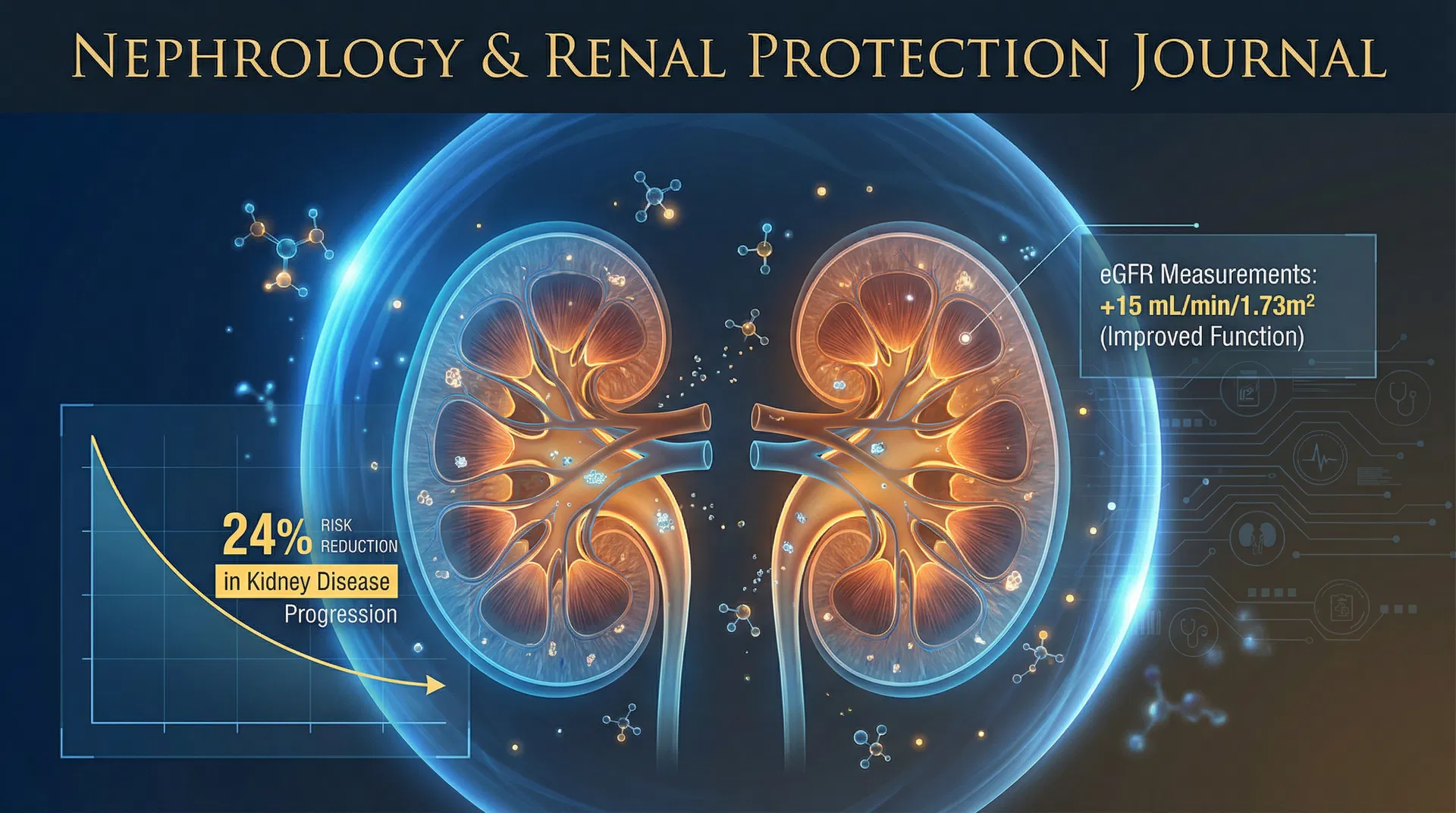
- Hazard ratio: 0.76 (95% CI, 0.66-0.88; P=0.0003)
- 24% relative risk reduction in major kidney disease events
Individual Components:
- Sustained ≥50% eGFR decline: HR 0.69 (31% reduction)
- Kidney replacement therapy: HR 0.84
- Cardiovascular death: HR 0.71 (29% reduction)
- Death from kidney causes: Too few events for separate analysis
The kidney-specific composite (excluding cardiovascular death) showed a 21% risk reduction (HR 0.79) [1].
Kidney Function Preservation
Beyond the primary endpoint, semaglutide demonstrated meaningful preservation of kidney function:
- Annual eGFR slope: Semaglutide slowed the rate of eGFR decline by approximately 1.16 mL/min/1.73m² per year compared to placebo
- UACR reduction: Semaglutide reduced urinary albumin-to-creatinine ratio by approximately 24% compared to placebo at week 104
- These effects suggest that semaglutide provides genuine nephroprotection, not just cardiovascular benefit that indirectly helps kidney outcomes [1].
Cardiovascular Co-Benefits
FLOW also demonstrated significant cardiovascular benefits in this CKD population:
- MACE (cardiovascular death, MI, stroke): HR 0.82 (18% reduction)
- All-cause mortality: HR 0.80 (20% reduction)
- Heart failure hospitalization: Significantly reduced
These findings were consistent with the SELECT trial results and extended the cardiovascular evidence to a high-risk CKD population [1].
Subgroup Analysis by Kidney Function
A subsequent analysis by Tuttle et al. examined outcomes across different levels of baseline kidney function:
- Benefits were consistent across eGFR categories (25-50 and 50-75 mL/min/1.73m²)
- Benefits were consistent across UACR categories
- Semaglutide reduced risks of major kidney disease events and all-cause death across wide-ranging categories of baseline kidney function
- This suggests semaglutide's nephroprotective effects are not limited to a specific CKD severity [2].
Interaction with SGLT2 Inhibitors
An important prespecified analysis examined whether semaglutide's benefits were influenced by concomitant SGLT2 inhibitor use (another class of kidney-protective drugs):
- Approximately 25% of participants were using SGLT2 inhibitors at baseline
- Semaglutide's kidney and cardiovascular benefits were consistent regardless of SGLT2 inhibitor use
- This suggests the two drug classes may provide additive kidney protection, supporting combination therapy in high-risk CKD patients [3].
Safety in CKD
The safety profile in this vulnerable CKD population was reassuring:
- Gastrointestinal events: More common with semaglutide but generally mild-to-moderate
- Serious adverse events: 49.6% semaglutide vs. 53.8% placebo (numerically lower with semaglutide)
- Acute kidney injury: No increased risk with semaglutide
- Hypoglycemia: Low rates in both groups
- No new safety signals specific to the CKD population [1].
Clinical Implications
FLOW established semaglutide as a kidney-protective therapy, with several important implications:
-
New treatment pillar for diabetic kidney disease: Semaglutide joins SGLT2 inhibitors and finerenone as evidence-based therapies for slowing CKD progression in diabetes.
-
Complementary mechanisms: Unlike SGLT2 inhibitors (which work on tubuloglomerular feedback) or finerenone (mineralocorticoid receptor antagonism), semaglutide's nephroprotection likely involves anti-inflammatory, anti-fibrotic, and metabolic pathways.
-
Cost-effectiveness: A long-term analysis by Rossing et al. projected that adding semaglutide to standard of care was highly cost-effective over the long term in people with T2D and CKD [4].
-
Guideline updates: FLOW data is expected to influence KDIGO and ADA guidelines for CKD management in diabetes.
References
-
Perkovic V, Tuttle KR, Rossing P, et al. "Effects of Semaglutide on Chronic Kidney Disease in Patients with Type 2 Diabetes." New England Journal of Medicine. 2024;391(2):109-121. PubMed: 38785209
-
Tuttle KR, et al. "Kidney and Survival Outcomes with Semaglutide by Baseline eGFR and UACR." Journal of the American Society of Nephrology. 2025. PubMed: 41706532
-
Perkovic V, et al. "Effects of semaglutide with and without concomitant SGLT2 inhibitor use in participants with type 2 diabetes and chronic kidney disease in the FLOW trial." Nature Medicine. 2024. DOI: 10.1038/s41591-024-03133-0
-
Rossing P, et al. "A long-term cost-effectiveness analysis based on FLOW." Diabetes Care. 2025. PubMed: 41422027