STEP 8: The Definitive GLP-1 Comparison
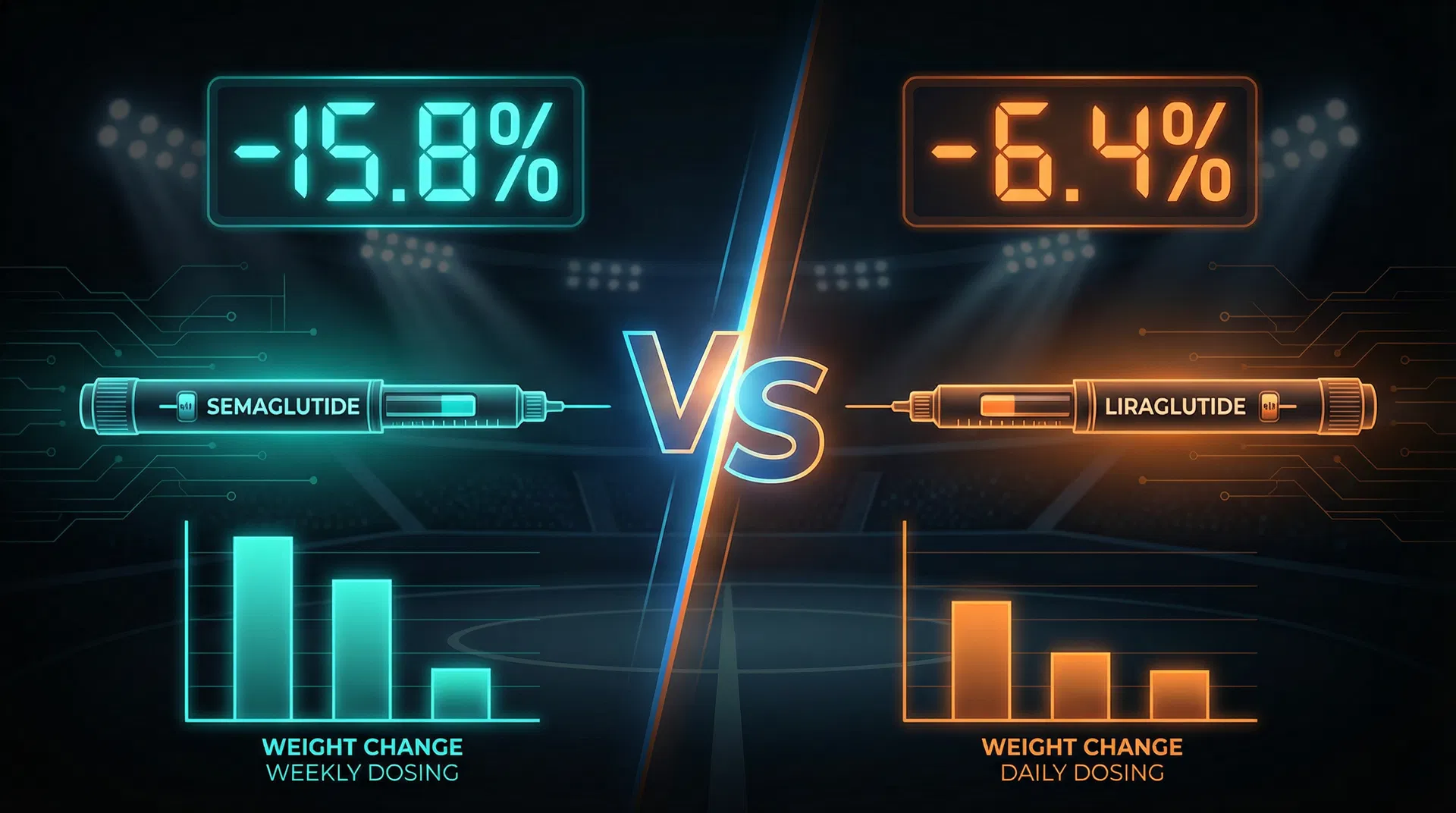
Before the STEP 8 trial, clinicians and patients had to rely on indirect comparisons between semaglutide [blocked] (Wegovy) and liraglutide (Saxenda) — the only two GLP-1 receptor agonists approved for chronic weight management. The STEP 8 trial, published in JAMA in January 2022 by Rubino et al., provided the first direct head-to-head comparison, definitively establishing semaglutide's superiority [1].
Study Design
STEP 8 employed a unique four-arm design:
- Enrollment: 338 adults
- Population: BMI ≥30, or BMI ≥27 with at least one weight-related comorbidity, without diabetes
- Arms:
- Semaglutide 2.4 mg once weekly (n=126)
- Semaglutide-matched placebo once weekly (n=85)
- Liraglutide 3.0 mg once daily (n=127)
- Liraglutide-matched placebo once daily (n=not separately reported)
- Duration: 68 weeks
- Design: Open-label between semaglutide and liraglutide groups, double-blind against respective placebos
The open-label design between active treatments was a practical necessity — semaglutide is injected weekly while liraglutide requires daily injections, making true blinding between the two drugs impossible [1].
Ready to explore this therapy with expert guidance? The clinical team at Telegenix offers personalized peptide and TRT [blocked] consultations backed by real lab work and evidence-based protocols. Book a free consultation today.
Weight Loss Results
The head-to-head comparison left no ambiguity:
Mean Body Weight Change at Week 68:
- Semaglutide 2.4 mg: -15.8%
- Liraglutide 3.0 mg: -6.4%
- Treatment difference: -9.4 percentage points (95% CI, -12.0 to -6.8; P<0.001)
Semaglutide produced approximately 2.5 times the weight loss of liraglutide.
Categorical Weight Loss:
- ≥10% weight loss: 70.9% semaglutide vs. 25.6% liraglutide
- ≥15% weight loss: 55.6% vs. 12.0%
- ≥20% weight loss: 38.5% vs. 6.0%
At every weight loss threshold, semaglutide dramatically outperformed liraglutide [1].
Why Is Semaglutide More Effective?
Several pharmacological factors explain semaglutide's superiority:
-
Longer half-life: Semaglutide's half-life of approximately 7 days (enabling weekly dosing) provides more consistent GLP-1 receptor activation compared to liraglutide's 13-hour half-life.
-
Higher receptor occupancy: The sustained plasma levels of semaglutide maintain higher and more consistent GLP-1 receptor occupancy in the brain's appetite-regulating centers.
-
Greater CNS penetration: Semaglutide appears to cross the blood-brain barrier more effectively, enhancing its central appetite-suppressing effects.
-
Dose optimization: The 2.4 mg weekly dose of semaglutide was specifically optimized for weight management, while liraglutide 3.0 mg was adapted from its diabetes dose [2].
Cardiometabolic Comparisons
Semaglutide also outperformed liraglutide on cardiometabolic parameters:
| Parameter | Semaglutide | Liraglutide |
|---|---|---|
| Waist circumference | -13.6 cm | -6.4 cm |
| Systolic BP | -5.6 mmHg | -2.1 mmHg |
| CRP reduction | -58% | -27% |
| Triglycerides | Greater reduction | Modest reduction |
The greater improvements in inflammatory markers (CRP) and waist circumference with semaglutide suggest more profound metabolic benefits beyond weight loss alone [1].
Safety Comparison
Both drugs had similar safety profiles consistent with the GLP-1 receptor agonist class:
- Gastrointestinal events: Similar rates between groups (nausea, diarrhea, vomiting)
- Discontinuation due to AEs: 3.2% semaglutide vs. 12.6% liraglutide
- The lower discontinuation rate with semaglutide despite greater efficacy is notable and may relate to the convenience of weekly vs. daily dosing
Injection Burden:
- Semaglutide: 1 injection per week (68 injections over the trial)
- Liraglutide: 1 injection per day (476 injections over the trial)
- Semaglutide required 7 times fewer injections, a significant advantage for adherence [1].
Patient Preference and Adherence
While STEP 8 did not formally assess patient preference, the practical advantages of semaglutide are clear:
- Weekly vs. daily dosing: Reduced injection burden improves adherence
- Greater efficacy: More motivating for patients to continue treatment
- Lower discontinuation: Suggests better overall tolerability
- Autoinjector device: Both drugs use pen-type autoinjectors, but the weekly schedule is more convenient
Real-world data has consistently shown that weekly GLP-1 receptor agonists have higher adherence rates than daily formulations.
Clinical Decision-Making
STEP 8 effectively settled the clinical question of which GLP-1 receptor agonist to prescribe for weight management:
-
Semaglutide is the preferred first-line GLP-1RA for weight management based on superior efficacy, lower injection burden, and comparable safety.
-
Liraglutide remains an option for patients who cannot tolerate semaglutide, prefer daily dosing (some patients find it easier to remember), or face insurance/access barriers to semaglutide.
-
Cost considerations: In some markets, liraglutide may be more affordable or have better insurance coverage, which can influence prescribing decisions.
Limitations
The open-label design between active treatment groups is a limitation, as knowledge of which drug they were receiving could have influenced participant behavior (diet, exercise adherence). However, the magnitude of the difference (9.4 percentage points) is unlikely to be explained by placebo effects alone. The relatively small sample size (338 total) is another limitation [1].
Related Comparison: Ozempic vs Mounjaro: Complete Comparison [blocked]
References
-
Rubino DM, Greenway FL, Khalid U, et al. "Effect of Weekly Subcutaneous Semaglutide vs Daily Liraglutide on Body Weight in Adults With Overweight or Obesity Without Diabetes: The STEP 8 Randomized Clinical Trial." JAMA. 2022;327(2):138-150. PubMed: 35015037
-
Bergmann NC, Davies MJ, Lingvay I, Knop FK. "Semaglutide for the treatment of overweight and obesity: A review." Diabetes, Obesity and Metabolism. 2023;25(1):18-35. PMC: 10092086
Take the next step in your optimization journey. If you're ready to move beyond research and into a supervised protocol, Telegenix offers physician-guided peptide and TRT programs with full lab support. Book a free consultation today.
Related Reading
Explore more in-depth guides on related topics:
- SURMOUNT-5 Trial: Tirzepatide Beats Semaglutide 2.4mg Head-to-Head for Weight Loss [blocked]
- Semaglutide for Weight Loss: How GLP-1 Receptor Agonists Are Changing the Game [blocked]
- Retatrutide vs Semaglutide vs Tirzepatide: How They Compare [blocked]
- STEP 1 Trial: How Semaglutide 2.4mg Achieved 15% Weight Loss in Adults [blocked]
- SURPASS-2 Trial: Tirzepatide Beats Semaglutide Head-to-Head in Type 2 Diabetes [blocked]
For a comprehensive overview, see our Complete Guide to Peptide Therapy [blocked].